
Local Bird Breeding Season Winding Down As Shift to Fall Migration Begins
As wild birds prepare for their long journeys, the annual Lights Out campaign officially kicks off.
Early August in south Louisiana can feel like summer is nowhere near finished, but the birds are already telling a different story.
In backyards, bayous, rice fields, neighborhoods, and tree lines, nesting season is starting to wind down for many of our resident and summer birds. At the same time, the first waves of fall migration are already moving through. That overlap makes this a busy, delicate stretch for birds, and for the wildlife rehabbers caring for them.
Some young birds are still learning how to fly. Some ducklings are still growing in care. Some migrants are already running into windows, cars, storms, exhaustion, and disorienting lights. Around here, late summer doesn’t bring a clean break between seasons. It brings a handoff.

Local breeding season is winding down, but it’s not over
By early August, many birds that nested in spring and early summer are finishing their breeding season. Some adults are quieter than they were in May and June. Fewer songbirds are defending territories with constant singing. Young birds that hatched earlier in the summer are now moving around on their own, even if they still look a little awkward.
In south Louisiana, that late-season mix can include familiar residents like:
Northern cardinals
Carolina wrens
Northern mockingbirds
Mourning doves
Black-bellied whistling ducks
Some species may still be feeding fledglings in August, especially birds that raise multiple broods or had delayed nesting attempts because of weather, predation, or disturbance. Mourning doves, cardinals, mockingbirds, and wrens can push late into the season. Black-bellied whistling ducks may also show up as late broods or late-arriving young birds needing help.
Summer visitors are shifting, too. Species that came here to breed, or that breed nearby in the Gulf Coast region, begin staging and moving before fall feels obvious to us. Purple martins gather in large groups before heading south. Barn swallows and other swallows start feeding heavily over fields and ponds. Orchard orioles can begin leaving surprisingly early. Some warblers that nested farther north may already be passing through.
So while the calendar says August, birds are working from a different schedule. They’re responding to day length, food availability, molt, weather systems, and internal migration cues.
Fall migration starts earlier than many people realize
When most folks think of fall migration, they picture October cold fronts and flocks moving across clear skies. That does happen, but migration starts long before sweater weather.
In south Louisiana, early fall migration begins in late July and August for some species. Shorebirds are often among the first obvious migrants, showing up in muddy fields, drainage areas, crawfish ponds, coastal edges, and wetlands. Yellowlegs, sandpipers, dowitchers, and plovers may pass through while summer heat is still sitting heavy over Acadiana.
Songbird migration also begins quietly. Early movers can include:

Yellow warblers
Prothonotary warblers leaving breeding areas
Northern waterthrushes
Louisiana waterthrushes
Orchard orioles
Flycatchers
Swallows
Purple martins
Ruby-throated hummingbirds later in the season
September and October bring larger pushes of warblers, vireos, thrushes, tanagers, buntings, grosbeaks, and other songbirds. Cold fronts can create big movement nights, especially when winds line up in their favor.
For wildlife rehabilitators, this timing matters. South Louisiana birds shift to fall migration and Lights Out for Migratory Birds becomes more than a seasonal slogan. It becomes the reality of daily care. Rehabbers may be feeding late-season fledglings in one room while receiving calls about fall migrants that struck windows in another.

For The Birds of Acadiana is in the seasonal crossover period
This is the stretch of the year when wildlife rehabilitation gets especially complicated.
In late spring and early summer, the work is heavily focused on baby birds, nestlings, fledglings, ducklings, and young birds separated from parents. By fall, more cases involve migration-related problems, including window strikes, cat attacks, exhaustion, dehydration, storm displacement, and vehicle collisions.
In early August, both are happening at once.
That means we are managing:
Nestlings that still need frequent feedings
Fledglings that need safe outdoor conditioning before release
Ducklings that need specialized housing, water access, heat support, and species-appropriate diets
Adult birds injured during breeding season
Early migrants hurt during travel
Birds weakened by heat, storms, or habitat loss
This crossover raises costs fast. Food needs change by species and age. Enclosures have to stay clean and safe. Migrants need quick assessment because time matters when a bird has a head injury or has been grounded during migration.
A baby bird in care needs feeding many times a day. A duckling group needs constant cleaning. An injured migrant needs careful monitoring after a collision. None of these patients pause for the season to change neatly.
Donations are needed while more than 100 birds remain in our care*
For The Birds of Acadiana still has over 100 birds in care, including 40 federally protected black-bellied whistling ducklings and wood ducklings. *Data as of August 8, 2026
That’s a lot of mouths, bedding, formula, mealworms, seed, fish, specialized waterfowl food, medical supplies, cleaning supplies, and enclosure maintenance. It’s also a lot of time.
Wildlife rehabilitation is often invisible work. People see the release photos, but they don’t always see the weeks of feeding, cleaning, laundry, and recordkeeping that happen first.
Donations help keep that care going through this hard seasonal overlap. They help cover the everyday things birds need to survive until they’re strong enough to return to the wild.
If you’ve ever wondered whether a small donation matters, it does. Your support provides us the resources to make sure the birds in our care receive the best possible chance of survival, with the ultimate goal of release back into the wild. To help us out, use this link to our ongoing Taking Flight Fundraiser or click the button below.
Lights Out for Migratory Birds (it matters in suburban neighborhoods, too!)
Most songbirds migrate at night. That includes many warblers, vireos, thrushes, tanagers, orioles, buntings, grosbeaks, and sparrows. Night travel helps them avoid daytime predators, conserve water, and use stars and natural light cues to navigate.
Artificial light can throw that system off.

Bright lights can attract and disorient migrating birds, especially when skies are cloudy, foggy, or rainy. Birds may circle lit areas, waste needed energy, become trapped in developed areas, or collide with windows and buildings. Even when they avoid an immediate collision, they can land in poor habitat and face more risks the next morning.
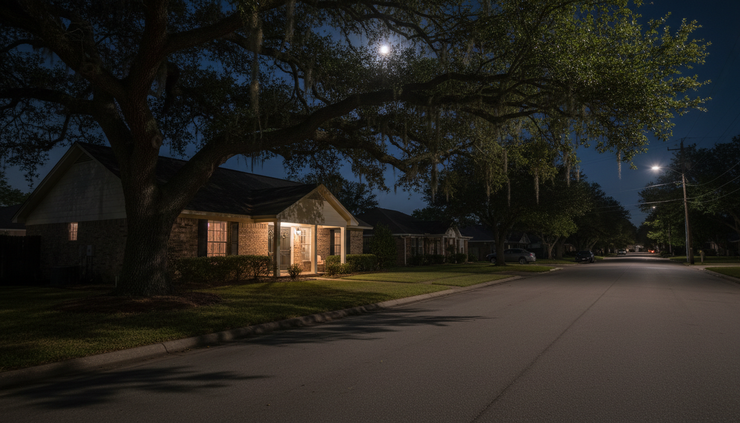
The problem isn’t only downtown buildings or skyscrapers. Suburban light matters. Porch lights, floodlights, landscape lighting, security lights, lit windows, and decorative lighting can all add up, especially in tree-filled neighborhoods where migrants stop to rest and feed.
A few widely accepted migration and collision facts help explain why this matters:
Most migratory songbirds travel at night, and estimates suggest hundreds of millions to as many as one billion birds die from building and window collisions in the United States each year.
Research and migration monitoring groups consistently warn that artificial light increases risk for nocturnal migrants. In suburban areas, the danger often shows up as a combination of light and glass. Lights pull birds toward homes, patios, schools, churches, stores, and neighborhood buildings. Reflective or transparent windows then become hazards at dawn, when birds start moving again.
Turning lights out is one of the simplest ways to help. During migration season, especially from August through November in fall, try to:
Turn off unnecessary outdoor lights from 11 p.m. to sunrise
Close curtains and blinds at night
Use motion sensors instead of steady lights
Aim security lights downward
Choose warm, shielded lighting when outdoor light is needed
Avoid decorative uplighting on trees and buildings
Treat windows that birds strike during the day
Lights Out doesn’t mean living in the dark. It means using light only where it’s needed, when it’s needed, and in a way that doesn’t pull birds off course.
What to do if you find an injured or orphaned bird
Finding a bird in trouble can feel stressful, especially when it’s tiny, scared, or hurt. The right first steps can make a big difference.
If the bird is a fledgling
A fledgling is a young bird with feathers that is learning to fly. It may hop on the ground, flutter short distances, and call for parents. This is normal.
If the fledgling is uninjured, alert, and in a safe-ish spot, the best help is usually to keep pets and people away. Parents are likely nearby, even if you don’t see them.
If the fledgling is in immediate danger, you can move it a short distance to nearby cover, like a shrub or low branch. The parents will still care for it.
If the bird is a nestling
A nestling has little or no feathers and cannot hop well. If you can safely find the nest, place the nestling back. Parent birds do not reject babies because of human scent.
If the nest is destroyed or you can’t reach it, contact a licensed wildlife rehabilitator for guidance.
If the bird hit a window
A window-struck bird may sit still, breathe heavily, tilt its head, hold its wings oddly, or seem stunned. Even if it flies off later, it may have a serious injury.
Place the bird in a ventilated box lined with a soft towel. Keep the box dark, quiet, and warm. Do not offer food or water unless a rehabber tells you to. Then contact a licensed rehabilitator as soon as possible.
If a cat caught the bird
A bird caught by a cat needs professional help, even if there are no obvious wounds. Cat saliva can introduce dangerous bacteria through tiny punctures.
Place the bird in a secure box and contact a rehabilitator right away.
If you find a duckling
Ducklings need heat, safety, and the right setup. They can chill quickly, and they do not do well when handled repeatedly. If a duckling is alone, injured, cold, or unable to keep up with the group, reach out for help.
Do not put a domestic setup together and try to raise wild ducklings yourself. Black-bellied whistling ducks, wood ducks, and most native birds are protected under federal law.
The Migratory Bird Treaty Act protects migratory birds
The Migratory Bird Treaty Act protects most wild birds in the United States, including their eggs, nests, feathers, and body parts. That means people cannot keep, raise, relocate, or treat federally protected birds without proper permits.
For The Birds of Acadiana can help guide next steps if you find an injured or orphaned bird in the region. Even if a bird doesn’t need intake, getting good advice can prevent accidental harm.
The bird’s location
What happened, if known
Whether there are visible injuries
Whether the bird is alert or weak
A clear photo, if you can take one without stressing the bird
Whether cats, dogs, windows, cars, or lawn equipment were involved
Quick, calm action gives the bird its best chance.
FAQ
When does fall bird migration start in south Louisiana?
Some migration begins in late July and August, especially shorebirds and early songbird migrants. Bigger songbird movements usually build through September and October, often around cold fronts.
Should I turn off lights every night during migration?
Yes, when you can. The most helpful window is from about 11 p.m. to sunrise during migration season. If safety lighting is needed, use motion sensors, shielded fixtures, and downward-facing warm lights.
Is a baby bird on the ground always abandoned?
No. Many fledglings spend time on the ground while their parents feed them nearby. If the bird is feathered, alert, and uninjured, it often needs space more than rescue.
Can I give an injured bird food or water?
It’s best not to unless a licensed rehabilitator tells you to. Injured birds can aspirate, choke, or worsen their condition if handled or fed incorrectly.
Who can I contact for help with a bird in Acadiana?

A small nighttime habit can save birds
Early August puts south Louisiana in two seasons at once. Local breeding is winding down, late fledglings and ducklings still need care, and the first fall migrants are already moving through our neighborhoods.
That makes this the time to help in practical ways. Keep cats indoors. Watch for window strikes. Give fledglings space when they’re safe. Call a permitted rehabber when something is wrong. Donate if you’re able, because more than 100 birds are still depending on daily care.
And at night, turn out the lights.
If you’d like a simple reminder for your fridge, classroom, clinic, camp, or community space, you can support our work and spread the message with the Lights Out for Migrating Birds educational magnet.
Remember, picking up an injured wild bird without transportation or a transportation plan crosses the line from a rescue to an illegal delay in care.
Let’s work together for the sake of preservation of our precious avian wildlife.
Stay informed about our latest rehabilitation efforts and get behind-the-scenes updates on our work with avian wildlife. Subscribe to our FREE V.I.B (Very Important Bird) list today and soar with us in making a difference! https://www.forthebirdsofacadiana.com/vip-list

220 Cambridge Dr.
Lafayette, LA 70503
337-501-4523
We are a licensed, non-profit wildlife rehabilitation facility funded solely through donations. Thank you for your support.
For The Birds of Acadiana is a non-profit organization, classified as tax-exempt under section 501(c)(3) of the Internal Revenue Code. Contributions may be deductible to the extent permitted by applicable laws. Consult with your tax professional for details. Our Federal Tax ID number is 85-1024416.


