
Avian Wildlife Rescue FAQ: What to Do When You Find an Injured Bird
Updated: Sep 9
Finding an injured bird can feel urgent and confusing. The right help usually starts with three simple steps: keep the bird safe, reduce stress, and contact a licensed avian wildlife rehabilitator. This FAQ explains what to do, what not to do, and how The finder becomes the first link in the rescue chain.

Start here if the bird is injured right now
What should I do first when I find an injured bird?
Move slowly. Keep people and pets away. Then decide whether the bird can be safely contained.
If the bird is on the ground, bleeding, unable to fly, hit by a window, attacked by a cat, tangled in line, or sitting in a dangerous spot, it likely needs help.
Use this basic plan:
Prepare a container
Use a cardboard box with air holes. Line it with a clean towel or paper towels.
Wear gloves if available
Gloves protect you and the bird. They also help you avoid oils, dirt, or accidental scratches.
Cover the bird gently
Use a towel. Darkness helps calm most birds.
Place the bird in the box
Keep the box closed. Do not use a wire cage if the bird is panicked or unstable.
Keep the box warm, dark, and quiet
Avoid loud rooms, children handling the box, and repeated checking.
Call a permitted wildlife rehabilitator
Follow their instructions. They may ask about the bird’s size, condition, location, and how the injury happened.
Should I give the bird food or water?
No. Do not put food or water into a wild bird’s mouth.
Injured birds can choke or inhale liquid. The wrong food can cause harm. A cold, shocked, or head-injured bird may not be able to swallow safely.
Keep the bird quiet and contained. Let a rehabilitator decide when feeding is safe.
Should I keep checking on the bird?
Limit checks. Opening the box adds stress and gives the bird a chance to escape indoors. Stress can make injuries worse.
Check only when needed, such as before transport or if a rehabilitator asks for an update.
Frequently asked questions about For The Birds of Acadiana's operations
Can For The Birds of Acadiana send someone out to pick up injured birds?
No. For The Birds of Acadiana does not operate like an emergency animal-control service with a rescue truck sent to every call.
Avian wildlife rescue often depends on the person who found the bird. The finder becomes the first link in the rescue chain. That means safely containing the bird, contacting the organization, and transporting the bird to their facility.
This model is common in wildlife rehabilitation. Most rehabilitators have limited staff, limited space, and many animals in care. They must focus their time on medical care, feeding, cleaning, and release preparation.
Who is responsible for capturing and transporting the bird?
The finder is responsible for capturing and transporting the bird to the rehabilitator
This does not mean the finder must handle a dangerous situation. Safety comes first. A small songbird in a yard is different from a hawk near traffic.
If the bird is large, in a roadway, on private property, or stuck in a dangerous place, ask the rehabilitator what to do before trying to capture it.
Is it legal for citizens to handle and transport wild birds?
In many cases, a citizen may briefly contain and transport an injured wild bird to a licensed wildlife rehabilitator. The goal must be rescue, not keeping the bird.
Federal and state laws protect many wild birds, especially native migratory birds. In the United States, the Migratory Bird Treaty Act protects most native bird species. State rules also apply. Wildlife rehabilitators need permits to provide ongoing care.
This post is informational only and is not legal advice. For a specific situation, follow guidance from a permitted rehabilitator, your state wildlife agency, or U.S. Fish and Wildlife Service resources.
The safe rule is simple: short-term rescue transport is different from possession. Do not keep the bird as a pet. Do not try to raise it. Do not post it for adoption. Get it to a permitted expert.
What if I cannot transport the bird?
Consider asking a friend, neighbor, coworker, or family member to transport it.
If you are unable to transport the bird or find someone to transport it, then it is advised to not contain the bird and ask someone with transport to contain it instead. Picking up an injured wild bird without transportation or a transportation plan crosses the line from a rescue to an illegal delay in care.
The Medical Deadline
The moment a wild bird is contained, its stress levels spike drastically. Birds have incredibly high metabolic rates, and an injured bird may be suffering from shock, internal bleeding, severe dehydration, or fractures.
Delayed Care is Fatal: If you contain a bird but have to spend the next 24 to 48 hours posting online looking for a driver, the bird is being deprived of life-saving medical stabilization (such as professional fluids, oxygen therapy, or pain management).
The Better Approach: If you absolutely cannot transport the bird or find a volunteer immediately, it is often safer to leave it where it is (or keep a visual eye on it) until another "Good Samaritan" is able to assist.

Questions about safe handling and containment
How do I capture a small injured bird?
Use a towel or light cloth. Approach slowly. Place the towel over the bird, then gently scoop it up with both hands.
Put the bird into a prepared box right away. Close the lid. Keep the box in a quiet place.
Do not hold the bird for comfort. Wild birds do not find human touch comforting. They feel safer in quiet darkness.
What if the bird is a hawk, owl, heron, pelican, or other large bird?
Call a rehabilitator or your state wildlife agency for instructions. If the bird is in traffic, call local authorities for road safety support.
Do not grab it with bare hands. Large birds, raptors, wading birds, and waterbirds may require extra caution.
What if the bird is caught in fishing line?
Do not cut all visible line and walk away. Fishing line can remain wrapped around wings, legs, tongue, or body. Hooks can be hidden.
If you can safely contain the bird, place it in a box and call a rehabilitator. If the bird is in water, on a pier, or still tangled in a tree, ask for help before acting.
Bring any loose line or tackle with the bird if it is safe to do so. That can help the rehabilitator find all injury points.
What should I do after a cat or dog catches a bird?
The bird needs help even if it looks fine.
Cat bites and scratches can cause serious infection. Dog bites can crush tissue or cause internal injury. Birds often hide weakness until they are very sick.
Contain the bird in a box and contact a rehabilitator as soon as possible.
What if the bird hit a window?
Place the bird in a covered box and keep it quiet. Call a rehabilitator for advice.
Some birds recover after a short rest. Others have head trauma, eye injury, or internal damage. Do not release the bird just because it stands up quickly. A rehabilitator can help decide whether release is safe.
To prevent more strikes, reduce reflections on problem windows. Use external decals, screens, cords, netting, or other visible patterns placed close enough together that birds do not try to fly through the reflection.
Questions about baby birds
I found a baby bird on the ground. Does it need rescue?
Not always.
Many young birds leave the nest before they fly well. These are called fledglings. They may hop on the ground, flutter short distances, and call for parents. This stage can be normal for many species - but not all.
A fledgling usually has feathers, open eyes, and can sit upright. If it is alert and not injured, keep pets away and watch from a distance. The parents may be nearby. If you're not sure, ask a permitted avian rehabilitator for advice.
A nestling is different. Nestlings may have bare skin, closed eyes, sparse feathers, or trouble sitting upright. They belong in a nest.
Can I put a baby bird back in the nest?
Yes, if you can do it safely. The common claim that parent birds reject babies touched by humans is false for most birds.
If you know the nest location and the bird is warm and uninjured, place it back. Then leave the area so the parents return.
If the nest fell, a rehabilitator may suggest a temporary replacement nest, such as a small container with drainage and soft nesting material. Get instructions first when possible.
What if I cannot find the nest?
Call a rehabilitator. They may ask for photos, the exact location, and the bird’s condition.
Do not feed the baby bird. Baby birds need species-specific diets and feeding methods. Feeding the wrong food can cause choking, bone problems, or digestive issues.

Questions about disease, safety, and public health
Can wild birds carry diseases?
Yes, wild birds can carry parasites or diseases, but basic precautions lower the risk.
Use gloves or a towel. Wash hands after contact. Clean any surfaces that touched the bird or box. Keep the bird away from pets, children, food areas, and household birds.
If you find several dead or sick birds in one area, contact your state wildlife agency. Disease events need proper reporting.
What should I do if I find a dead bird?
Do not handle it with bare hands. Local rules vary.
If it is a single dead bird with no sign of a larger issue, your local sanitation or animal control office may have disposal guidance. If there are multiple dead birds, or the bird is a raptor, waterbird, or unusual species, report it to the state wildlife agency.
Should I worry about avian flu?
Avian flu can affect wild birds, poultry, and other animals. Risk to the general public varies by situation, but it is smart to avoid direct contact with sick or dead birds.
Do not bring sick wild birds near backyard chickens or pet birds. Use gloves. Wash hands. Contact a rehabilitator or state wildlife agency for current local guidance.
Questions about identification and communication
What information should I give the rehabilitator?
Give short, clear details.
Useful information includes:
Exact location where the bird was found
Bird size and appearance
Injury signs
How long the bird has been contained
Cause of injury if known
Whether a cat, dog, window, car, fishing line, or glue trap was involved
Photos, if the rehabilitator asks
What if I do not know the bird species?
That is fine. Describe it in plain terms.
Compare it to familiar birds. Is it sparrow-sized, robin-sized, crow-sized, duck-sized, or goose-sized? Note beak shape, leg length, color, and where it was found.
A clear photo from a safe distance can help, but the bird’s condition matters more than perfect identification.
Questions about transport
How should I transport an injured bird?
Keep the bird in a closed, ventilated cardboard box. Place the box on the floor of the vehicle or secure it so it cannot slide.
Keep the car quiet. Do not play loud music. Do not let passengers open the box. Do not transport the bird loose in the car.
Avoid extreme temperatures. Never leave the bird in a parked car.
Can I bring the bird to a veterinarian?
Some veterinarians accept wildlife for transfer to a rehabilitator. Others do not. Call first.
Wildlife care rules vary by state and species. A permitted avian wildlife rehabilitator is usually the best first contact. They can tell you whether a vet visit is needed and where to go.
Can I release the bird myself after it looks better?
Not without guidance. A bird that looks alert may still have injuries. Head trauma, puncture wounds, internal bleeding, and wing damage can be hard to see.
Release also needs the right timing and location. The safest choice is to ask a permitted rehabilitator before releasing any bird that was injured or contained.
What does it mean when a state agency tells me to let nature take its course?
When a rehabber, state or federal agency advises you to "let nature take its course," it typically means that they believe the natural processes should be allowed to unfold without human intervention. This can apply to situations when an injured bird can continually and adeptly evade capture. The agencies may feel that interfering could cause more harm than good, and that allowing natural processes to occur will lead to a more balanced and sustainable outcome.
Questions about what not to do
Can I keep the bird overnight?
Only if a rehabilitator instructs you to do so or no safe transfer is possible until the next day.
If overnight holding is necessary, keep the bird in a closed box in a quiet indoor location. Do not feed it. Do not handle it. Keep pets away.
Call again as soon as the rehabilitator opens or responds.
Can I raise an orphaned wild bird myself?
No. That would be illegal. Wild birds need specialized diets, housing, federal permits, and release preparation. Raising a bird incorrectly causes malnutrition, bone disease, poor feather condition, imprinting, and loss of survival skills. It is illegal to possess any wild native American bird without proper permits for any length of time.
The legal frameworks, such as the Migratory Bird Treaty Act, require specialized licensing through agencies like the U.S. Fish and Wildlife Service to ensure animals receive expert care.
Can I post online asking what to feed it?
Posting can help find transport or a rehabilitator. It should not replace expert care.
Online feeding advice is usually wrong. Even well-meaning tips can harm the bird. Ask for help locating a licensed rehabilitator instead.
Can I use a cage, laundry basket, or plastic bin?
A cardboard box is usually better. It is dark, quiet, and less likely to damage feathers.
If you use a plastic bin, add air holes and secure the lid. Do not use airtight containers. Avoid wire cages for injured birds because they may panic and injure themselves.
How the community can help avian wildlife rescue
Wildlife rehabilitation is not only the work of trained rehabilitators. It takes a network.
People can help by:
Donating towels, paper towels, gloves, and cleaning supplies
Keeping cats indoors or supervised
Making windows safer for birds
Removing fishing line and litter
Sharing accurate rescue instructions
Supporting local permitted rehabilitators
For The Birds of Acadiana and similar groups depend on responsible finders. Every safe box, careful drive, and timely call gives an injured bird a better chance.
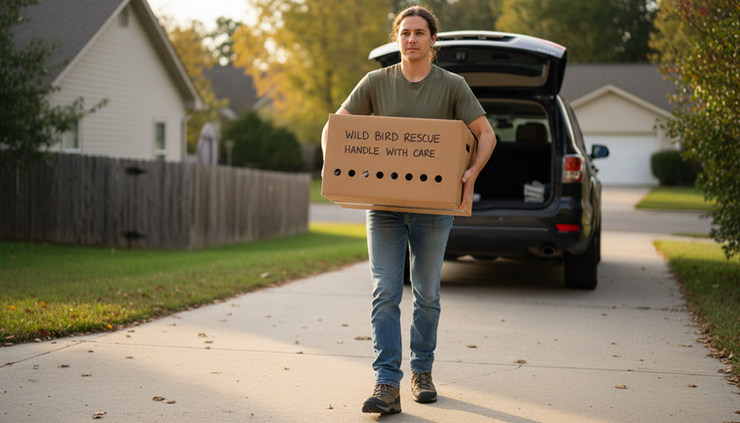
Keep this quick checklist ready
If you find an injured bird, remember this:
Contain
Use a ventilated box and a towel.
Calm
Keep the bird warm, dark, and quiet.
Do not feed
Food and water can harm an injured bird.
Call
Contact a licensed wildlife rehabilitator.
Transport
Bring the bird to permitted care.
Ask for help
If you cannot drive, say so and look for a transporter.
Fast, calm action saves lives. The best rescue starts with a responsible finder, a quiet box, and a call to someone licensed to take the next step.
Let’s work together for the sake of preservation of our precious avian wildlife.
Stay informed about our latest rehabilitation efforts and get behind-the-scenes updates on our work with avian wildlife. Subscribe to our FREE V.I.B (Very Important Bird) list today and soar with us in making a difference! https://www.forthebirdsofacadiana.com/vip-list

220 Cambridge Dr.
Lafayette, LA 70503
337-501-4523
We are a licensed, non-profit wildlife rehabilitation facility funded solely through donations. Thank you for your support.
For The Birds of Acadiana is a non-profit organization, classified as tax-exempt under section 501(c)(3) of the Internal Revenue Code. Contributions may be deductible to the extent permitted by applicable laws. Consult with your tax professional for details. Our Federal Tax ID number is 85-1024416.


